On being a postman

After Stanley came home I started applying for jobs.

Lagom was closed for business and I needed to find a way to earn money again. But I was still very anxious about my capacity to do work, and about anything that would involve being away from home.

So my job search had a few strict criteria, including: proximity to my house, regular hours, and taking no work home.

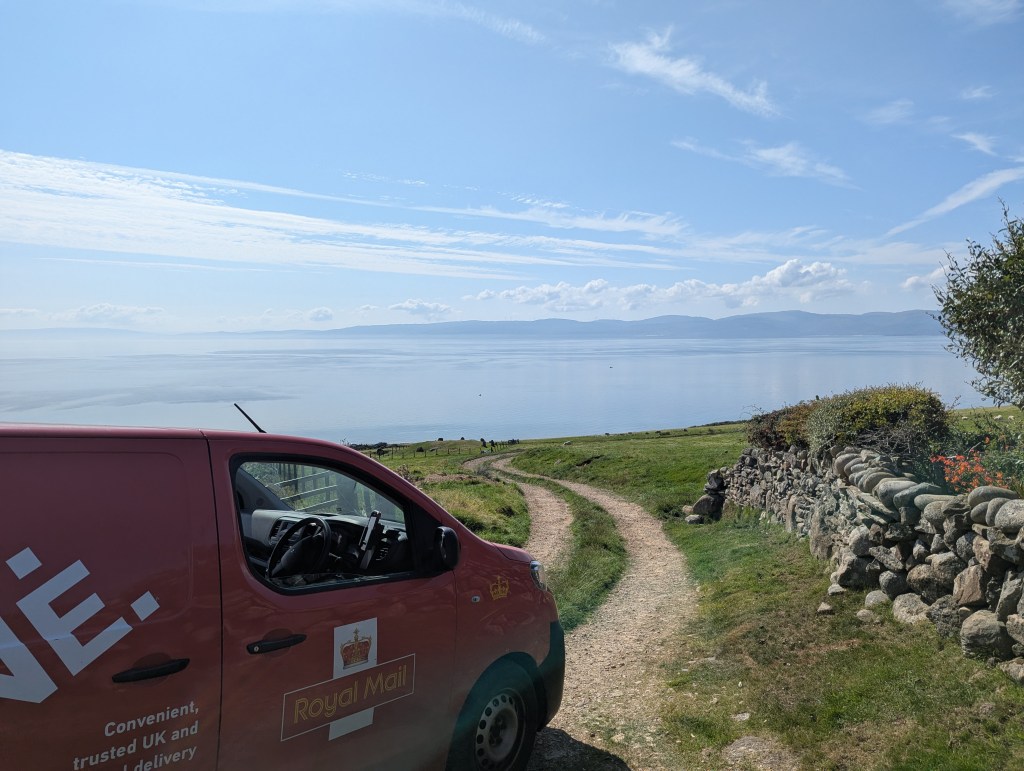
That led me to a job for the Royal Mail, delivering mail and parcels to the west coast of Arran, 4 days a week.

A photo of my Royal Mail van on a farm track, with the sea in the distance

The job advert said I’d be working in the open air and walking up to 16 miles a day. After spending months cooped up in Glasgow hospitals, I quite liked the sound of that. 

The reality isn’t all strolling down country lanes whistling a cheery tune of course. There’s a lot more sorting, carrying, dirt and sweat involved. 

The work is a mix of memory challenge, solving little puzzles every day, and physical endurance. 

At its best, I’ve found it very rewarding – grateful farmers coming out of their houses to meet me, knowing that I’d be bringing them that crucial bit of kit they’d been waiting for. But there are a lot of bumpy tracks, and delivering toilet rolls to empty holiday homes too.

There are 450 addresses on my route, almost all of which have individual Gaelic names rather than house numbers. After a few weeks on the same route I’d managed to memorise most of the house names and their sequence, and could sort the mail without reference to my notes.

Every day has felt like a race to get home. I imagine the longer you do the role, the less it feels like that. But for me, I’ve known that the consequence of any time wasted (by taking longer to sort the mail or load the van, or stopping to chat, or looping back round to deliver a missed parcel) would be felt at the end of each day. So I’ve always just pressed on, not once stopping for a break or lunch. 

On a good day I start at 8, I’m in my van on the road by 10, and home by 4. Some days I’m out much longer than that. Even on easier days I’ve still felt the pressure to get round quickly, when getting home by 3.30 might be the reward.

I’ve learned a little bit about a lot of people on my route. And I’ve learned to curse fiddly gates, sharp letter boxes and dogs.

I’ve been continuously impressed by my colleagues. They are relentlessly can-do, only occasionally grumpy, and I’ve been in awe of the depth of their knowledge about all the routes and people on the island, and their dedication to the task.

The work has prompted lots of thoughts about the service design of the Royal Mail, some of which appears to be extremely impressive, some of which leans too heavily on the memory and conscientiousness of individual members of frontline staff. But that’s for a different post.

This week is my last as a postman. I’m going to be moving on to a role that looks a bit more like the other things on my CV. I’ve sorted and delivered thousands of parcels and tens of thousands of letters over the last few months. I’d happily do it again.

Blog posts by me published in other places

I’ve been doing some filing.

I’ve imported some of the blog posts I’ve published in other places onto this blog so that I have a record in one place. Here they are:

Selected blog posts that were first published on lagomstrategy.net:

Selected blog posts that were first published on digitalhealth.gov.uk:

Selected blog posts that were first published on blogs.fco.gov.uk:

Some reflections on closing down Lagom

Liam posted last week that we are in the process of closing down Lagom Strategy.

In many ways it’s a sad time because the business has been a big part of my life. Liam established Lagom 12 years ago. I turned up 7 years ago, first as an associate, and then later as a director alongside Liam and Helen.

We devoted ourselves to building a great business, making digital public services more user centred, and doing it all in a lagom way.

We built a great team: user researchers, service designers and delivery managers. And I think we did some genuinely brilliant pieces of work for our NHS, central government, and public sector-adjacent clients.

So I do feel sad that it’s ending. But not too sad. All things change, and Lagom may have just come to a natural end point.

As Liam said, the pendulum swing away from SMEs like Lagom in public sector procurement had already affected the work we were able to win. We managed to keep winning work for longer than some, but it had definitely got harder. And a lot of our work was with, or via, NHS England, which has been in a fairly constant process of change, making some of our best work frustratingly uncertain.

We had already reduced the size of our team to reflect this new reality. My own recent period of compassionate absence wasn’t decisive, but it wasn’t very helpful timing.

So we stopped trying to win work a little while ago, and we’re now well into the process of closing the business down.

As we do so, I think we can feel good about the work we’ve done. Personally, I feel extremely grateful that Helen and Liam invited me to join them. The Lagom ethos (do good things, advocate for the user above all else, quality over quantity…) was already established when I joined. But I found that it suited me very well, enabling me to do the most rewarding work, in a way that made sense to me, with people I really enjoyed working with.

I think we were at our best delivering gnarly, difficult discovery projects, where most of the work was user research, but mixed in with a dash of politics, and some tricky tech and design options.

We did our share of more straightforward pieces of work too, but they were less satisfying. I think the Lagom team came into its own when we found some big ideas, a set of genuine of problems to solve, a distracted client, some awkward stakeholders, and users who barely had time to participate in our research. Our work on clinical placements for NHS England was like this. Really important; maddening at times; and a brilliant Lagom team quietly making sense of it all.

Lagom was never just the work though. I’ll miss the catch ups, the team days, the Hot Topics, the quick debriefs, the virtual coffees. I reckon we did a lot of things right.

I am very thankful to have worked with a great team. I loved working with Adam, Charlotte, Emma, Hannah, James, John and Victoria. Reducing the size of the team was a painful experience, however lagom we might have wanted to be about it.

And I’ve been extremely grateful to Liam and Helen during the last few months in particular, when their support has enabled me to step back, despite the pressures it must have created on them.

I don’t know what’s next yet. I don’t have a job to go to, or much of a plan. But whatever we all do, I hope it will still be lagom.

The last 198 days

On 3 September my son collapsed at home and everything else stopped.

His bowel had twisted and blocked, causing him to go into septic shock. He survived the ambulance and the helicopter, and the surgery. And he kept on surviving though multiple procedures, surgeries and infections.

Last week, after 198 days in hospital, he came home. He’s not better, but he’s home, and that’s good.

Hospital lifts and signs

The Queen Elizabeth University Hospital has 1000 beds over 14 floors, with thousands of daily visitors. So it needs a good way for people to travel up and down the building.

And the lift system appears to be cleverly designed. It’s one with no buttons to press on the inside of the lift. Instead, the user calls the lift they need by selecting a floor on a panel outside. This panel then shows them which lift to take, based on available capacity. Simple.

Panel of buttons used to call a lift

This seems like a smart way to distribute people between the 6 lifts in the most efficient way. What’s more, the design anticipates a few different use cases:

  • A person in a wheelchair may need more room than a person standing, so there’s a button for that
  • A group of people take up more room than a single person, so people in groups can indicate how many people are in their group

But maybe other lift users aren’t as interested in lift system design as I am. Some people still get into the first lift that arrives anyway; groups of people rarely indicate so; plenty of people just stand around waiting and scratching their heads.

The design appears to break most people’s long established mental model for how they expect lifts to work. And to compensate for this, a rich ecosystem of signs and posters has evolved on the walls outside each lift:

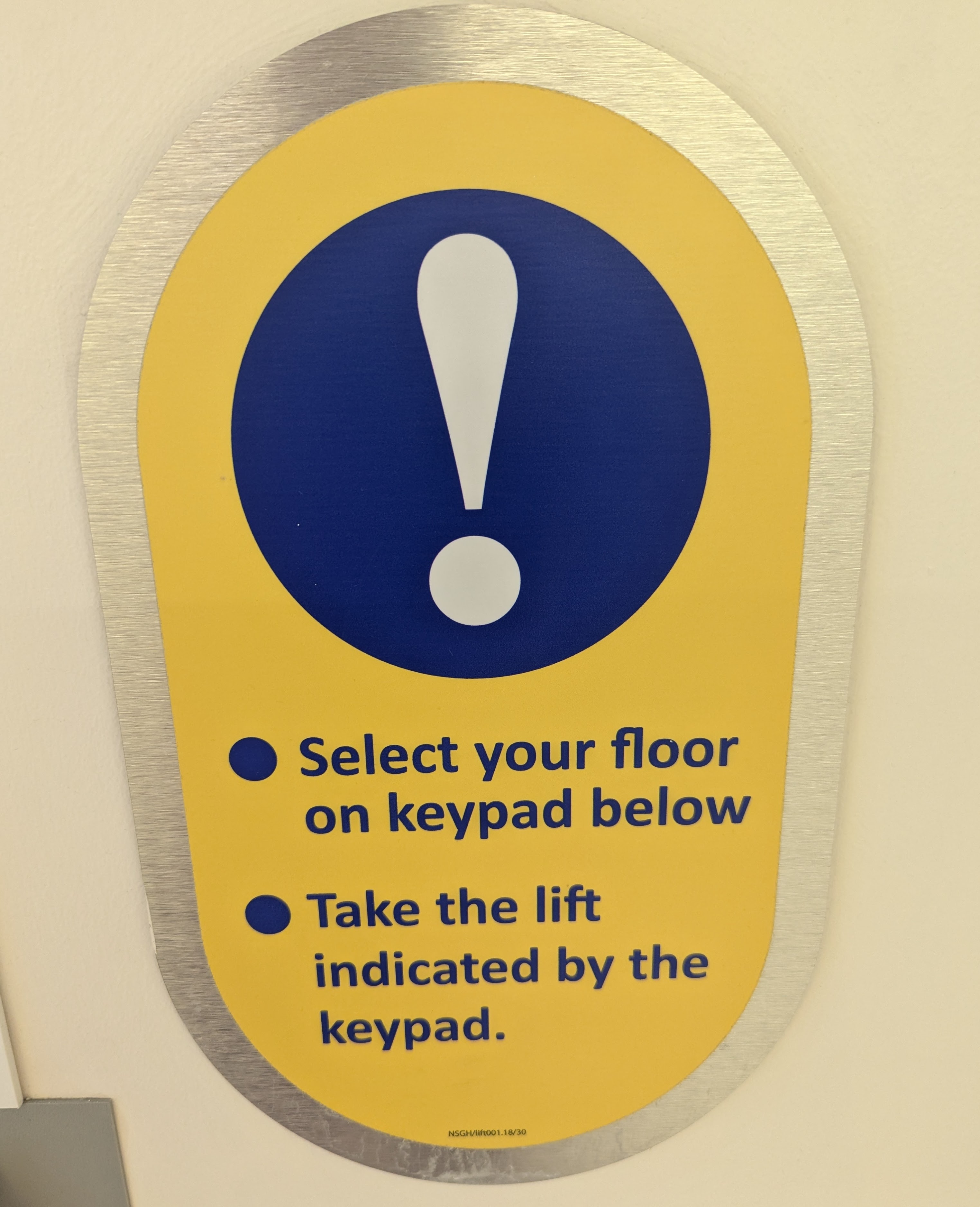
The official sign:

Official sign explaining how to call a lift

A longer prose version, printed on A4, put in a plastic sleeve and blue-tacked to the wall:

Detailed guidance on how to use a lift printed on A4 and stuck to the wall

Another slightly less polished description of how to use the buttons, printed on A4 and blue-tacked again:

Guidance on how to use the lift printed on A4 and curling up at the edges

…with versions of these signs on every floor outside every lift.

Of course, nobody reads signs like these. But they suggest a flaw in design process, rather than any fault on the part of the people trying to get around the hospital.

In this case, a tiny amount of user research would reveal users (ill patients and stressed hospital visitors) becoming confused or irritated trying to work out how to do something that they thought they already knew how to do. Knowing that might lead to a tweak in the design to test again.

And that might lead to slightly calmer, slightly more punctual people in the hospital, and a maybe a few fewer signs stuck to the walls.

Moments of contentment

I’ve had reasons to feel scared and sad over the last few months. At times it has felt like everything has gone, or is about to go, wrong.

As an exercise to try to snap myself out of dark thoughts, I started adding to a note on my phone, listing times I remember feeling most happy.

I was trying to remember very particular, personal moments of contentment, so that I could shut my eyes and reexperience how I felt.

The result is an incomplete list of snapshots. Short memories of specific vivid feelings, rather than achievements. Quiet moments rather than milestones.

There’s a bias towards some types of memory because of the context in which the list was made.

This list may only be of interest to me. But the process of making it was helpful, forcing me to briefly immerse myself in a different, better emotional state.

A Forest game with Dad on a tandem ticket, listening to Radio Nottingham then Sports Report in the traffic jam on the way out of the Council House car park, whistling the theme tune trying not to laugh.

Climbing to the loch above Thunderguy. Hamish doing the thing where you appear on both ends of a panoramic photo, except I film it instead of take a photograph.

Commentating on toy cars Olympics on the small table in the caravan.

Cooking tortilla and tomato salad for Dominic and Dominic at the Albert Square flat before a Cinimo practice.

Cricket camp with Stanley. Getting there early covered in sun cream. Coaching. Tournaments. The day he took an all-bowled hat-trick.

Doing a bar shift at Kimberley, pouring pints of mixed.

Drinking Guinness with Tom, Beggsy, Trevor and whoever, back at the otherwise empty clubhouse, after a Sunday away match, a bit too late with work tomorrow.

Driving across Nottingham having borrowed Mum’s Fiat Panda, with all the windows down and Radio Trent on, wearing white Reeboks.

Driving hundreds of miles to an away match with Stanley. Arriving 2 hours before kick off and staying at the end. Newcastle, Aston Villa, Forest, Wolves, Man City, Man United.

Driving to Poppy’s house in Cumbria, listening to The Don Declares on cassette.

Easter egg hunt in the garden, Alice has bought 1000 eggs. I hide some carefully, but scatter the rest, then set the rules for Hamish in front of the steps.

Eating a whole artichoke with a pot of olive oil, lemon, vinegar and a boiled egg, with Alice. Alice having the same, except the egg. Watching 2 episodes of 24.

Getting a train to Freemantle for falafel.

Getting piped into the hall before Stanley is made Dux.

Walking round and round St James’s Park rehearsing how to say things to myself.

Going back to Kimberley or Dulwich cricket clubs years later, and having the same conversations with the same people as if I’d never been away. John Parkin, John Lawrence.

Going to every day of the Grand Prix with Stanley. Impersonating people talking boringly about better routes/queuing systems/logistics.

Going to the fifth day of the test match against New Zealand on a whim with Stanley. Moeen Ali taking the catch to win the game.

Going to the nets in Dulwich Park with Stanley really early in the morning. Videoing him playing cover drives and bowling.

Grandma and Grandpa arriving for Christmas in Nottingham with a cardboard box full of Coca Cola and lemons.

Having 2 pints of Red Stripe at The Greyhound with Poppy.

Having cake, a bath and a nap, then running the fines meeting after a day skiing.

Holy Isle day trip with Mum, Dad, Alice and Stanley. Stanley running the length of the island like Alistair Brownlee. Mum sitting on a rock.

Lying on the carpet at the end of the night, listening to Ride.

Making the tiered garden at Martell Road. Sitting in it in the sun on a Sunday morning.

Mowing the lawn.

Mum drives me to a field at lunchtime, I sprint across it, then we have sandwiches.

One v one cricket with Chris against the garage door in Havant, or in the garden in Bognor.

Overrhearing Dad reverting to his school days when talking to Wally on the phone.

Playing Aussie Rules with Chris and Chris on the playing fields and in the swimming pool at the weekend.

Playing cricket with Mark in the car park next to the house in Withington.

Playing for Dulwich at home, Alison brings me a big courgette from her garden, scoring 64, having a shower, Fran and Alistair are there too for some reason.

Playing Slow Dog, Fast Chicken with Hamish in his room.

Practicing Ingenious Friend songs with Malcolm and Wilko in Ken’s tiny rehearsal room.

Reading a novel in a tent, on a train, or in a palaza in Slovenia or Italy, interrailing.

Rock Trip to Dr Montfort Hall to see Pixies. Alison going down to the mosh pit.

Running the 200 meters in the KEEN Cup after Mum persuaded me to.

Seven-a-side football tournament on a sandy pitch in Échirolles for Priory Celtic, a towel over my head to shade the sun between matches. Mum is there.

Sitting round a tree at playtime with Sarah, Emma and Ross. And the school trip to the Isle of White, listening to The Chicken Song.

Sleeper train to Inverness with Alice. No beds, so sat upright dozing, with Sigur Ros on repeat in my headphones.

Stanley blogging about going to see Palace away at Man United. His description of walking back along the canal in the rain after an unlikely win.

Taking Stanley to see Grandpa in Bognor, while Alice visits Kerry.

Talking to the Vietnamese government about the internet in Hannoi. Showing them pictures of Stanley and the allotment.

Three on three football match in the back garden. Hamish, Stanley and Sam v Joseph, Gavin and me. Hamish scores the winning goal.

Two player Fifa career mode with Stanley, as Dortmund. Gareth Bale scoring the winner in the Champions League semi final.

Villa degli Dei in Nocelle with Alice, having bread and jam and coffee in the morning, with a Joe Sacco book.

Walking to the Ritzy with Alice, drinking a bottle of Becks in the bar before a film.

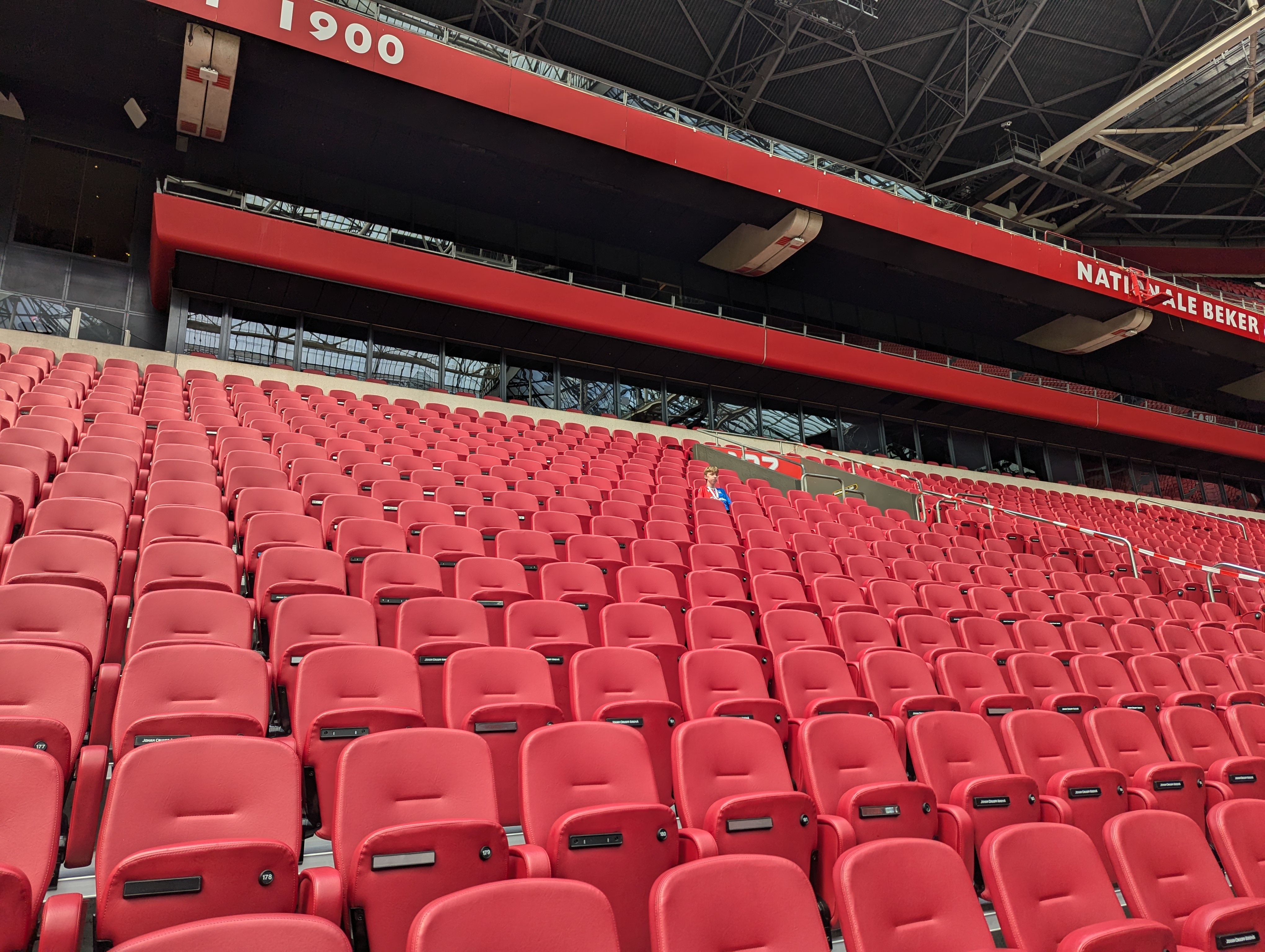
Wandering through the red light district in Amsterdam with Stanley.

Watching a cricket match sat on a bench at Kimberley (or anywhere) with the sun on my face and tightly cut grass under my feet.

Watching Sperts Porsonality of the Year and getting a text from Matt Jaffa about the length of the applause.

Water fight on the last day of school. Getting Stanley from the top window in Martell Road. Later, being careful not to get Hamish too much in Murray Crescent.

Working an evening shift at The Lavender. Poppy comes in on her way back to Oval after a shift at Oddbins.

Wrestling with Stanley on his bed in West Norwood. Him doing the “ABERDEEN” move.
Allow yourself to become obsessed

Stanley writes well about football.

Then the moment came, in the dying seconds of the game, Franca burst forward down the right hand side, and floated a ball just over Mateta, who didn’t give up, chased Bernado Silva, who had tormented us all game, and robbed him of possession, a scrap ensued, Ozoh was initially tackled inside the area, but the ball ran loose, and Mateta once again gallivanted on to it, sticking out a leg and getting to it before Phil Foden, who before he could realise what was happening, had tripped Mateta, sending our big lump of chaos flying.

Low expectations, frustration and uncontrolled jubilation: Manchester City 2-2 Crystal Palace, from the away end

Dark patterns of service design: my 81 year old dad and a mobile phone contract he didn’t ask for

Summary: My dad found himself signed up to a mobile phone contract that he didn’t ask for or need. I helped him try to cancel it and make a complaint, and when that didn’t work I helped him refer the case to the Communications Ombudsman. 

The case was resolved in our favour (with nothing owed and no contract), but only after 165 days of frustration and anxiety, caused by often incoherent, sometimes threatening communications from Virgin Media, O2, and their appointed debt collectors.

I’m recording the story here, because I think it needs to be written down somewhere. Maybe a user researcher or service designer working for Virgin Media will make use of it. I hope so.

Here’s what happened:

On 15 September 2023 my dad took a phone call from a Virgin Media salesperson. During that call, my dad agreed to renew his existing contract for his broadband and television. He remembers a conversation about adding Netflix to his TV package, but he remembers no mention of a mobile phone contract, or O2. This is important, because that’s what the rest of this story (over the next 6 months) is all about.

It seems (although I don’t know for sure) that during that phone call, the salesperson signed my dad up to a 2 year mobile phone contract with O2, and an associated direct debit. 

I don’t know exactly what was said on that phone call. Perhaps there was a misunderstanding. Maybe something more nefarious was going on. Either way, the result was that my dad’s details (including his bank details) were passed from Virgin Media to O2, and he was signed up to a contract that he didn’t ask for or need. 

Two weeks after that phone call my dad showed me some text messages he had received from O2, and a sim card that had arrived in the post. He had initially disregarded the text messages as spam, because he had never had any dealings with O2 (and had no idea that O2 was in fact part of Virgin Media).

He called Virgin Media, who advised him to go into an O2 store, which he did, travelling to Nottingham with the sim card in his pocket to ask a salesperson to make calls on his behalf to cancel any unwanted contracts.

When he told me about this I was baffled. My dad is 81 years old. He didn’t request or need a mobile phone contract. And it seemed weird that he had been told to travel to a shop as the only way to sort it out. So I wrote to Virgin Media on his behalf to point out what I described at the time as “thoughtlessly inconsiderate” treatment of an ageing customer.

I thought that would be the end of the matter. But then money started to be taken from my dad’s bank account.

He tried to pursue this via customer service channels, without success. And then when he had exhausted those routes, we started the first of several exchanges with the Virgin Media and O2 complaints processes. 

I helped my dad fill in web forms, and write emails. I now have a folder full of the messages we sent, charting each new development. It’s a dissertation worth of attempts to explain the sequence of events, setting out:

  • The original mis-selling
  • The weird advice to resolve it by going into an O2 shop
  • Setting up a new direct debit without permission
  • The transfer of bank details between Virgin Media and O2
  • The time it was taking to resolve
  • The inadequate, confusing responses to our complaints
  • A request for reimbursement for money taken
  • A request to cancel any unwanted ongoing contract

My dad received some automated replies, and some longer (barely coherent) replies to our complaints that looked like they had been pieced together from a generic complaint response generator. He did not (and still has not) received a reply that addressed the substance of his complaint. 

Based on all the replies I’ve seen, I’m not convinced that anyone at Virgin Media or O2 has actually read any of the complaints we made.

At one point, Virgin Media responded saying that they “cannot check information on your O2 account because of the Data Protection Act”, which was particularly infuriating given that our complaint was actually about the passing of my dad’s bank details from Virgin Media to O2 without consent.

None of this prevented money being taken from my dad’s bank account. So my dad asked his bank to cancel any further payments, which they did.

The exchanges continued between September and December, with each of our complaints, followed by more demands for payment of increasing amounts.

After 8 weeks, we were eligible to register the case as a dispute with the Communications Ombudsman, which I did on my dad’s behalf. 

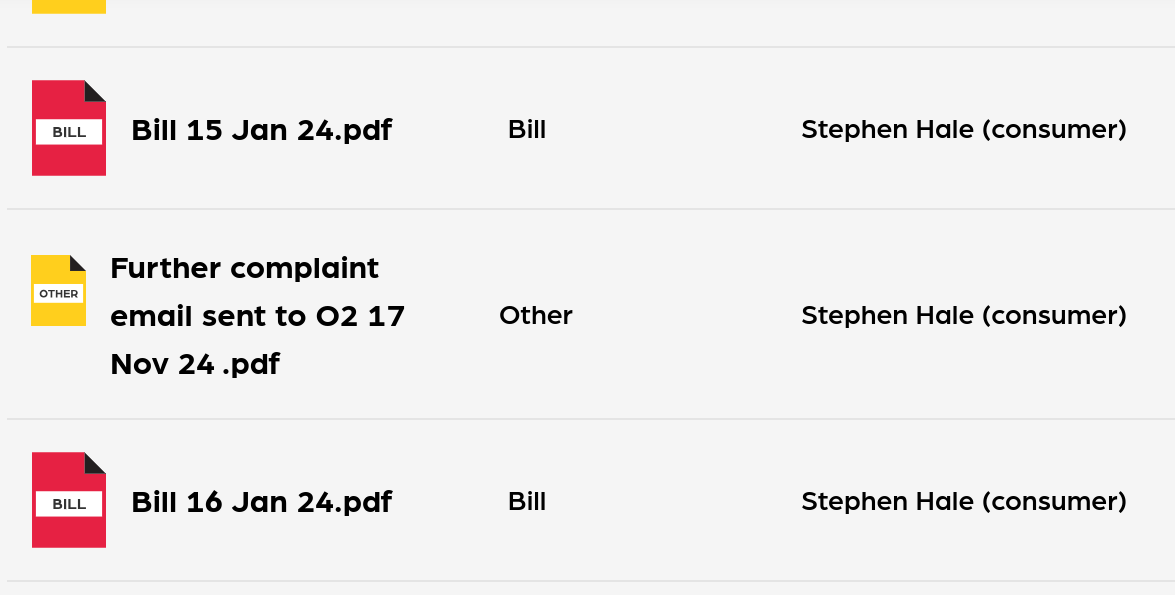
By contrast with the Virgin Media and O2 process, dealing with the Ombudsman was a delight. They had a process for verifying that I could act as a proxy. They assigned a case officer who phoned me to talk through the process. And they had a case management system which I used to upload the folder full of communications and complaints as evidence. 

Screenshot of the Ombudsman case management system, showing bills and complaints files shared as evidence

While I was doing this, O2 were escalating their threats, sending my dad daily messages demanding increasing payments, and punishments for non-payment. They threatened:

  • Fines for non-payment, to add to the amount owed
  • Reports to credit reference agencies
  • Referral to a debt collection agency
  • Bills for increasing amounts (for hundreds of pounds, covering the 2 year contract)

I think it was when my dad was contacted by the debt collectors that he was most distressed. He knew that we were following the Ombudsman process, but the thought of bailiffs knocking on his door really spooked him.  

On 27 January 2024, O2 accepted our case and offered a resolution (to cancel the contract and all billing, and withdraw credit rating reporting). I’m not convinced that anyone at O2 engaged with the substance of the complaint even at this point. It seems more likely that they offered a resolution to avoid the Ombudsman making a ruling. 

My dad accepted the resolution, via the Ombudsman. This gave O2 a further month to implement the resolution, during which time my dad continued to receive new bills from O2, and letters and phone calls from the appointed debt collection agency.  

On 27 February (165 days after the first phone call), the Ombudsman informed me that O2 had implemented the resolution, at which point the bills and debt collection letters stopped. 

It doesn’t feel much like justice, given all the anxiety and efforts involved, but it’s a massive relief that it seems to be over. 

My dad is 81 years old. I think that Virgin Media and O2 have cruelly caused him almost 6 months of unnecessary anxiety. Their service design is certainly negligent, and I suspect that their actions were at times nefarious, and not legal. 

My dad’s experience seems to be an inevitability of deliberate service design. I suspect that many others will have similar stories. And I imagine that others may not have had the will, capacity or persistence to pursue this as we did. 

The Ombudsman process seems to work and I am very grateful for that, but it really shouldn’t have been needed.